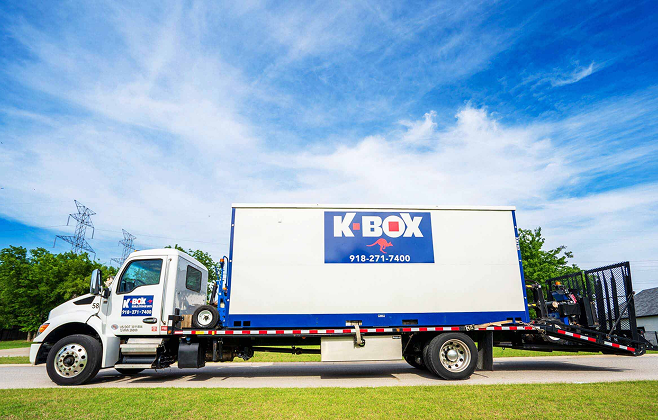
Choose the 19ft K-BOX if your load needs more than 128 square feet of floor space. Choose the 16ft if it fits under that number with room to spare. The 19ft adds 192 cubic feet and costs $40 more per month. Running out of room costs $248 the day it happens.
Most container size guides ask how many bedrooms you have. That question sends people home with the wrong box. This guide gives you a measurement instead.
16ft vs 19ft K-BOX: The Short Answer
Both K-BOX containers are 8 feet wide and 8 feet tall. Only the length changes.
| Spec | 16ft K-BOX | 19ft K-BOX |
| Dimensions | 16ft L x 8ft W x 8ft H | 19ft L x 8ft W x 8ft H |
| Floor space | 128 sq ft | 152 sq ft |
| Nominal volume | 1,024 cu ft | 1,216 cu ft |
| Usable volume | about 960 cu ft | about 1,140 cu ft |
| Weight capacity | 10,000 lbs | 10,000 lbs |
| Monthly rent | $179 | $219 |
| Transportation | from $69 per move | from $69 per move |
| Rough home size | up to 1,500 sq ft | up to 2,000 sq ft |
The 19ft gives you about 19 percent more space for about 22 percent more money. Per cubic foot, the two boxes cost almost exactly the same. Size is a capacity decision here, not a value decision.
Read the full specs on the 16ft K-BOX container and 19ft K-BOX container pages.
Why Room Counts Get Container Size Wrong
Room counts fail because two homes with the same floor plan hold wildly different amounts of stuff. A minimalist three-bedroom and a packed three-bedroom differ by hundreds of cubic feet. Bedroom count also ignores the three rooms that break most estimates. Garages, attics, and storage closets never appear in a bedroom number.
No National Size Chart Covers a 19ft Container
Here is the problem specific to Oklahoma renters. PODS lists its 16-foot container as its largest size. 1-800-PACK-RAT offers 8, 12, and 16-foot containers and stops there.
So every national size chart tops out at 16 feet. An Oklahoma customer reads one of those charts, sizes into a 16, and never learns a bigger box existed. K-BOX is one of the few Oklahoma providers running a 19ft unit at all.
Loading Style Changes the Answer by 20 Percent
Professional loaders pack tighter than homeowners do. Industry estimates put the gap at 15 to 25 percent more space for do-it-yourself loading. You are packing this container yourself over several days. Build that buffer into your estimate or you will run short.
The Floor-Plan Method for Sizing a Storage Container
Measure floor space instead of counting bedrooms. You stack everything to 8 feet anyway, so floor area is the real constraint. Here is the method in three steps.
Step 1: Add Up Your Big-Footprint Items
Every large item claims floor space that nothing else can use. Standing mattresses and tables on edge cuts their footprint dramatically.
- Three-seat sofa: 21 sq ft
- Sectional: 35 sq ft
- Queen mattress and box spring on edge: 7 sq ft
- King mattress set on edge: 9 sq ft
- Refrigerator: 8 sq ft
- Washer or dryer: 6 sq ft each
- Standard dresser: 8 sq ft
- Dining table on edge: 6 sq ft
- Treadmill: 18 sq ft
- Riding mower: 23 sq ft
Step 2: Convert Your Boxes to Floor Space
A medium moving box holds about 3 cubic feet. Stack boxes in a column 2 feet square and 8 feet tall. That column holds roughly 10 medium boxes and uses 4 square feet of floor.
The rule is simple. Every 10 medium boxes costs you 4 square feet.
Step 3: Add 20 Percent and Compare
Total your items and boxes, then add 20 percent for imperfect stacking and walking room. Compare the result against the two container floors.
- Under 120 sq ft: the 16ft K-BOX works.
- 120 to 150 sq ft: book the 19ft. You are too close to the line.
- Over 152 sq ft: you need the 19ft plus a second box, or you need to declutter.
What the Extra Three Feet of a 19ft Container Holds
Three extra feet sounds small. It is not.
Those three feet run the full 8-foot width and 8-foot height of the box. That is 192 cubic feet of added volume. At 3 cubic feet per medium box, the extra space swallows about 60 moving boxes.
Put differently, the 19ft gives you one more complete wall of stacked boxes, floor to ceiling. That is usually the difference between finishing the load and calling for a second container.
Weight Limits: Both K-BOX Sizes Stop at 10,000 Pounds
This is the detail almost every size guide skips. The 19ft holds more volume than the 16ft, but it does not hold more weight. Both K-BOX containers cap at 10,000 pounds.
The moving industry uses 7 pounds per cubic foot as its standard density factor for household goods. Run the math on both boxes and the picture gets clear. A fully packed 16ft comes in near 6,700 pounds. A fully packed 19ft comes in near 8,000 pounds. Normal household loads run out of space long before they run out of weight allowance.
Dense loads flip that. Books run 12 to 15 pounds per cubic foot. Tools, tile, pavers, and gym plates run higher still. A 19ft box packed with garage and workshop contents can hit 10,000 pounds while the box still looks half empty.
If you are moving a workshop, a library, or a home gym, say so when you call. The Move.mil weight estimator is a useful sanity check before you book.
What Renting the Wrong Container Size Costs
Guessing small and guessing big are not symmetrical mistakes. Here is the arithmetic on K-BOX’s published rates.
Sizing up from the 16ft to the 19ft costs $40 per month. Running out of room costs you a second 16ft container. That second box adds $179 in rent plus $69 in transportation. You pay $248 before a single item goes inside it.
You would have to keep the 19ft for six months before the upgrade matched what one overflow container costs on day one. And that ignores the real cost. A second container means a second delivery window, a second pickup, and a load split across two boxes.
Guessing big costs $40 a month. Guessing small costs $248 and a scheduling headache.
When the 16ft Container Is Still the Right Choice
The 16ft is the correct box in several real situations. Do not size up by reflex.
- Your driveway has less than 19 feet of level, unobstructed run.
- You are storing one or two rooms during a remodel.
- Your load is dense and weight-limited rather than volume-limited.
- You plan to store for a year or more, where $40 a month becomes $480.
- Your HOA restricts how much of a driveway a container can occupy.
Measure Your Placement Spot First
Walk out and measure before you book. You need a level run longer than the container itself, plus clearance for the delivery truck to set it down.
K-BOX places containers with the JOEY lift system, which allows tighter and more controlled placement than roll-off delivery. That helps on narrow Tulsa and Broken Arrow lots. It does not turn 16 feet of driveway into 19. Send your measurements with your quote request and the office will tell you straight.
Five Signs You Should Book the 19ft
Size up if any of these describe your situation.
- You are moving a three-bedroom home with a full garage.
- Your floor-plan total landed between 120 and 152 square feet.
- You own a sectional, a treadmill, or a riding mower.
- You are clearing a whole house for a renovation, not one room.
- You have never packed a container before and cannot picture the space.
That last one matters more than people expect. First-time packers consistently underestimate. The 19ft is the forgiving choice.
Frequently Asked Questions About 16ft and 19ft Container Sizes
What size storage container do I need for a 3-bedroom house?
Most three-bedroom homes need the 19ft container rather than the 16ft. The 16ft handles a lightly furnished three-bedroom with no garage contents. Add a garage, a sectional, or a home gym and you need the 19ft. Measure your floor-space total instead of trusting the bedroom count.
How much bigger is a 19ft container than a 16ft?
A 19ft K-BOX holds 192 more cubic feet than a 16ft K-BOX. That is 1,216 cubic feet versus 1,024, or about 19 percent more room. It adds 24 square feet of floor space, which is roughly 60 medium moving boxes.
Can I fit a 19ft container in my driveway?
You need more than 19 feet of level, unobstructed surface plus truck clearance. Many single-car Oklahoma driveways run 18 to 25 feet from garage to sidewalk. Measure the flat run before you book and send the number with your quote request.
Is it cheaper to rent two 16ft containers or one 19ft?
One 19ft container is far cheaper. A second 16ft costs $179 per month plus $69 transportation, or $248 up front. Upgrading from the 16ft to the 19ft costs $40 per month.
How much weight can a K-BOX container hold?
Both the 16ft and 19ft K-BOX hold up to 10,000 pounds evenly distributed. The 19ft gives you more volume, not more weight capacity. Typical household goods fill the space before they reach the limit. Dense loads like books, tools, and tile can hit 10,000 pounds early.
How to Book the Right K-BOX Size in Oklahoma
K-BOX is a locally and veteran owned company based in Tulsa. We deliver moving containers across Oklahoma to homes, businesses, and job sites. We also run construction job site boxes for contractors who need secure daily access.
Storage works three ways. Keep the box on your property, move it to a new Oklahoma address, or send it to our gated Tulsa lot. Outside storage with us carries no additional storage fee, and you can access your container while it sits there. Check the delivery areas we cover to confirm your city.
Tell us your zip code, your rough item list, and your driveway measurement. Our office manager, Marlena, will tell you which box fits. Get a quote online or call us at (918) 271-7400.
Recent Posts
How to Pack a K-BOX for Transport
Moving to a new place can be an exciting adventure, but the process of packing and moving can often feel overwhelming. One of the smartest…
Read More
Ideas for Moving With Young Children
It’s normal for children to feel like they have no control over a move. Additionally, they find it hard to say goodbye to friends. Help…
Read More
Learn to Prepare Furniture for a Move
Furniture can be difficult to lift and move without the help of strong friends or professional movers. Properly preparing to transport or store furniture can…
Read MoreReady to Book or Get a Quote?
Portable Moving Containers from The K-BOX are the Ultimate Solution for Your Moving Needs